



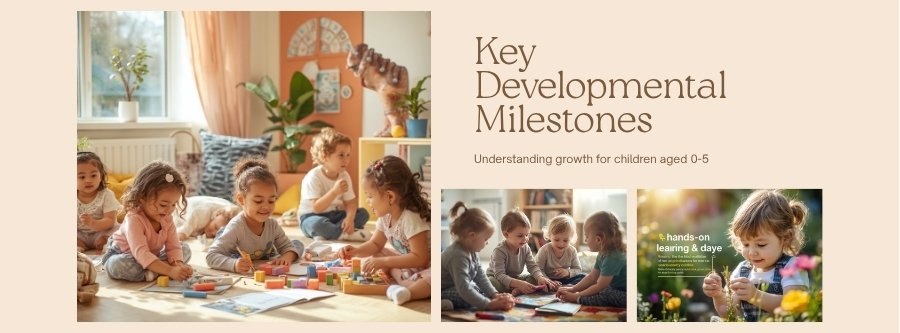
The first five years of a child’s life are a period of extraordinary growth. From the moment a newborn grasps a finger to the day a five-year-old tells a joke with deliberate comedic timing, children move through a remarkable sequence of developmental milestones that shape who they will become.
Developmental milestones are behaviours or skills that most children (typically 75 percent or more) can demonstrate by a certain age. They are not rigid pass-or-fail tests, but rather guideposts that help parents, educators, and health professionals understand whether a child’s development is broadly on track.
The Four Domains of Development
Child development is typically measured across four interconnected domains. Motor development encompasses both gross motor skills (crawling, walking, running, climbing) and fine motor skills (grasping objects, drawing, using utensils). Cognitive development refers to thinking, reasoning, problem-solving, and memory. Language and communication covers receptive language (understanding words), expressive language (speaking and gesturing), and the precursors to literacy. Social and emotional development includes forming attachments, managing emotions, playing cooperatively, and developing a sense of self.
These domains do not develop in isolation. A toddler learning to stack blocks is simultaneously developing fine motor control, cognitive understanding of spatial relationships, and, if playing alongside a peer, social skills like turn-taking and shared attention.
Milestones by Age
In the first 12 months, infants progress from reflexive movements to purposeful actions. Most babies can hold their heads up by two to four months, sit independently by around six months, and begin pulling to stand between nine and twelve months. Babbling typically begins around six months and evolves into first words by around twelve months. Socially, infants develop strong attachments to caregivers and begin to show stranger anxiety around eight to ten months.
Between one and two years, toddlers typically begin walking independently, start combining two-word phrases, and demonstrate emerging independence. Cognitive leaps include understanding object permanence and beginning simple pretend play. Emotionally, toddlers start to identify basic feelings, though managing those feelings remains a significant challenge.
From two to three years, children’s vocabularies expand rapidly, often reaching several hundred words. They begin to run, climb stairs, and use utensils with increasing confidence. Play becomes more imaginative, and children start to show interest in other children, though parallel play (playing alongside rather than with peers) remains common.
Three-to-four-year-olds typically speak in full sentences, ask endless questions, and begin to understand concepts like counting, colours, and time. They can pedal tricycles, cut with scissors, and draw recognisable shapes. Friendships become more intentional, and cooperative play emerges more consistently.
By age five, most children can hop, skip, and catch a ball. They recognise letters and numbers, write their name, and engage in complex storytelling. They understand rules, take turns in games, and show empathy when peers are upset. They are, in many ways, ready for the structured demands of formal schooling.
When to Seek Support
It is essential to remember that every child develops at their own pace. A child who walks at 15 months is no less healthy than one who walked at 10 months. However, persistent delays across multiple domains, or the loss of previously acquired skills, are signals that warrant a conversation with a paediatrician or child health professional. Early identification and intervention can make a profound difference in outcomes.
How Tracking Supports the Journey
For early childhood educators, systematically tracking milestones across all four domains provides a rich picture of each child’s unique developmental journey. Rather than relying on memory alone, digital tracking tools can reveal patterns over time, highlighting areas of rapid growth, emerging strengths, and domains that may benefit from additional support. Platforms like Personhood360 enable educators to capture these observations in real time, aligning them with wellbeing markers and developmental domains to create a holistic, evidence-based view of every child in their care.
Whether you are a parent checking in on your child’s progress or an educator documenting learning stories, understanding developmental milestones is the first step toward providing the responsive, individualised support that every child deserves.