



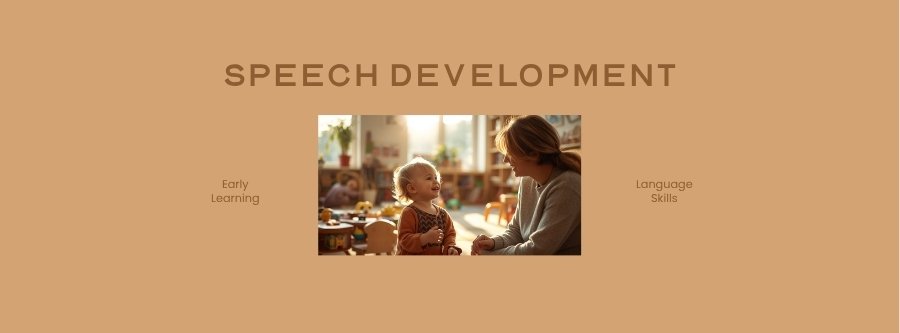
Few questions weigh on new parents quite like this one. The playground comparisons begin early, and the anxiety can be overwhelming. Understanding the natural timeline of speech development can provide both reassurance and clarity about when professional guidance might be helpful.
The Timeline of Early Speech
Speech and language development begins long before a child utters their first word. In the first few months of life, babies communicate through crying, cooing, and making eye contact. These early vocalisations are not random noise. They are the building blocks of language, as infants experiment with producing sounds and learn that their vocalisations elicit responses from caregivers.
Between four and six months, most babies begin babbling, producing repetitive consonant-vowel combinations like “ba-ba” or “da-da.” This is a critical stage: babbling signals that the brain’s language centres are actively developing and that the child is practising the motor movements needed for speech.
First words typically appear between 10 and 14 months, though the range extends from as early as 8 months to as late as 18 months in typically developing children. These early words are usually names for familiar people (“mama,” “dada”), objects (“ball,” “dog”), or social words (“bye-bye,” “no”). By 18 months, most children have a vocabulary of approximately 10 to 50 words.
The period between 18 and 24 months is often described as the “vocabulary explosion.” Children begin learning new words at a remarkable pace, sometimes several new words per day, and start combining two words into simple phrases: “more milk,” “daddy go,” “big truck.” By age two, most children have vocabularies of around 200 to 300 words and can be understood by familiar adults about half the time.
From two to three years, children progress to three- and four-word sentences, begin asking questions, and use language for increasingly complex purposes, including describing events, expressing preferences, and narrating play. By age three, strangers should be able to understand most of what a child says.
Understanding Receptive vs Expressive Language
An important distinction that often eases parental worry is the difference between receptive language (what a child understands) and expressive language (what a child says). Receptive language almost always develops ahead of expressive language. A child who is not yet saying many words but who clearly understands instructions, responds to their name, and follows simple directions is demonstrating that their language system is developing, even if spoken output is still catching up.
What Influences Speech Development?
Several factors affect the pace of speech development. Children in language-rich environments, where caregivers talk, read, and sing to them frequently, tend to develop language skills earlier. Birth order can play a role: first-born children sometimes speak earlier because they receive more one-on-one adult conversation, while younger siblings may benefit from the modelling of older children. Bilingual children may appear to have smaller vocabularies in each individual language initially, but their total vocabulary across both languages is typically on par with monolingual peers.
Recurrent ear infections that affect hearing can temporarily slow speech development, as children need to hear speech clearly to reproduce it. Boys, on average, develop speech slightly later than girls, though the difference is modest and temporary.
When to Seek Help
While variation is normal, certain red flags warrant a conversation with a health professional. These include: no babbling by 12 months, no words at all by 18 months, no two-word combinations by 24 months, loss of previously acquired language skills at any age, or consistent difficulty being understood by familiar people by age three. Early intervention for speech and language delays is highly effective, and the earlier support begins, the better the outcomes tend to be.
How Educators and Parents Can Support Speech Development
The most powerful tool for supporting speech development is responsive conversation. Narrating daily activities, expanding on a child’s utterances (child says “truck”; adult responds “Yes, a big red truck!”), and reading together daily all build the neural architecture for language.
In early childhood settings, educators who document children’s language milestones over time can identify emerging concerns early and share evidence-based observations with families. Tools like Personhood360 allow educators to track communication development alongside other domains, creating a comprehensive picture that supports timely intervention when needed.