



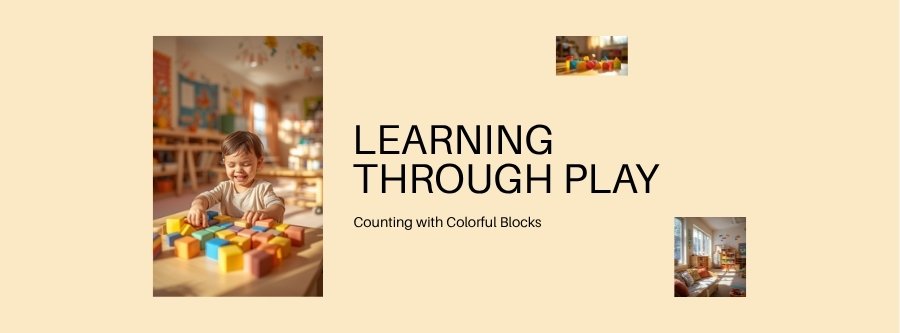
Parents often benchmark their child’s development against specific, tangible skills, and counting is one of the most visible. The ability to recite numbers feels like a clear, measurable sign of intelligence. But early numeracy is far more nuanced than rote counting, and understanding the distinction can help parents and educators support mathematical development more effectively.
Rote Counting vs Number Sense
There is a significant difference between rote counting (reciting numbers in sequence, like singing a song) and true number sense (understanding that numbers represent quantities). Most two-year-olds can recite some numbers in order, often up to five or so, though they may skip numbers or jumble the sequence. By age three, many children can rote count to 10, and by four, to 20 or beyond.
However, rote counting does not mean a child understands what the numbers represent. True number sense develops more gradually and includes concepts like one-to-one correspondence (touching each object once while counting), cardinality (understanding that the last number counted represents the total), and conservation of number (knowing that five blocks are still five blocks even when rearranged).
The Stages of Early Mathematical Development
Mathematical thinking in early childhood follows a rough developmental sequence. Between 12 and 24 months, toddlers begin to understand basic concepts of “more” and “less.” They notice when a group of objects changes size and show emerging understanding of spatial relationships (in, on, under).
Between two and three years, children begin to sort objects by attributes (colour, size, shape), create simple patterns, and demonstrate emerging counting skills. They may point to objects while counting, though they often skip objects or count the same one twice.
Three-to-four-year-olds develop reliable one-to-one correspondence with small groups (usually up to five), begin to recognise numerals, and can compare small groups to identify which has more. They also begin to understand ordinal concepts (first, second, third).
By four to five years, most children can count reliably to 20 or beyond, understand cardinality with groups up to 10, perform simple addition and subtraction with small numbers (often using fingers or objects), and recognise and name basic shapes. They also begin to understand measurement concepts like heavier/lighter and longer/shorter.
Supporting Numeracy at Home and in Early Childhood Settings
The most effective way to build mathematical thinking is to embed it in everyday experiences. Counting steps while climbing stairs, sorting laundry by colour, comparing quantities at snack time, and building with blocks all engage mathematical thinking in meaningful, contextualised ways.
Educators can extend these experiences by using open-ended provocations that invite mathematical exploration: loose parts for counting and patterning, water play for measurement concepts, and construction activities for spatial reasoning. The key is to make mathematical language explicit: naming numbers, shapes, positions, and comparisons during play brings abstract concepts into children’s conscious awareness.
Rather than focusing on whether a child can count to a specific number by a specific age, the priority should be developing a rich, intuitive number sense through hands-on, play-based experiences. Children who develop strong foundations in mathematical thinking during the early years are better prepared for the formal instruction that follows in primary school.
Tracking mathematical development alongside other domains helps educators identify where each child is on their learning journey. Personhood360 enables educators to capture these observations as part of each child’s developmental profile, ensuring that learning plans are responsive, individualised, and grounded in evidence.