



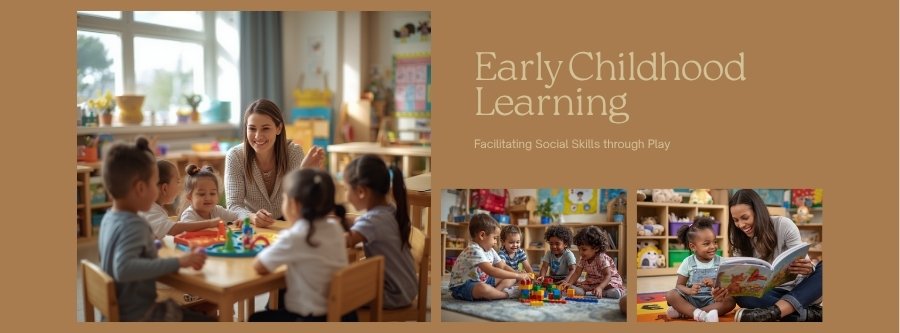
Social skills, sharing, turn-taking, empathy, cooperation, conflict resolution, and communication, are among the most important competencies children develop in the early years. And play is the most effective context for developing them. Unlike direct instruction, which can teach children what social skills look like, play teaches children how social skills feel: the lived experience of negotiating, compromising, and connecting with others.
Why Play Is the Ideal Social Skills Classroom
Social skills cannot be learned through lectures or worksheets. They require practice in authentic, emotionally meaningful contexts, and that is exactly what play provides. During play, children are intrinsically motivated, emotionally engaged, and navigating real social situations with real stakes. The conflict that arises when two children want the same toy is not a disruption to learning. It is the learning.
Intentional Environment Design
Educators can foster social skill development through thoughtful environment design. Dramatic play areas with multi-role scenarios (shops, restaurants, hospitals, veterinary clinics) invite cooperative play and role negotiation. Limited quantities of popular materials create natural opportunities for sharing and turn-taking. Large-scale projects (murals, construction builds, gardening) require collaboration. Small, enclosed spaces (cubby houses, reading nooks) encourage intimate social interaction.
Scaffolding Social Interactions
The educator’s role during play is to observe, support, and scaffold, not to take over. When a child is struggling to enter a play group, the educator might coach them. When conflict arises, the educator can facilitate problem-solving rather than imposing a solution. When a child demonstrates prosocial behaviour, the educator can name it: “You noticed that Aiden was sad and gave him a hug. That was kind.”
Games That Build Specific Social Skills
Certain types of play are particularly effective for developing specific social skills. Turn-taking games (board games, ball games, musical instruments) develop patience and impulse control. Cooperative games (where children work together toward a shared goal rather than competing against each other) develop teamwork and communication. Role-play and puppetry allow children to practise social scenarios in a safe, low-stakes context.
The Importance of Unstructured Social Play
While structured activities have their place, the richest social learning often occurs during unstructured play. When children must negotiate their own games, establish their own rules, and resolve their own disputes without adult intervention, they develop the autonomous social competence that will serve them for life. Educators who resist the urge to intervene at the first sign of conflict, and instead observe and allow children to practise problem-solving, support deeper social learning.
Tracking social skill development through play gives educators the evidence needed to plan responsive, individualised support. Personhood360 allows educators to document social interactions during play, link them to developmental domains, and identify children who may benefit from additional scaffolding, ensuring that every child builds the social competence they need to thrive.