



Teaching numbers to preschoolers is less about drilling facts and more about building mathematical understanding through meaningful, hands-on experiences. The most effective approaches embed number concepts into play, daily routines, and real-world contexts, making mathematics a natural, enjoyable part of children’s lives.
Concrete Before Abstract
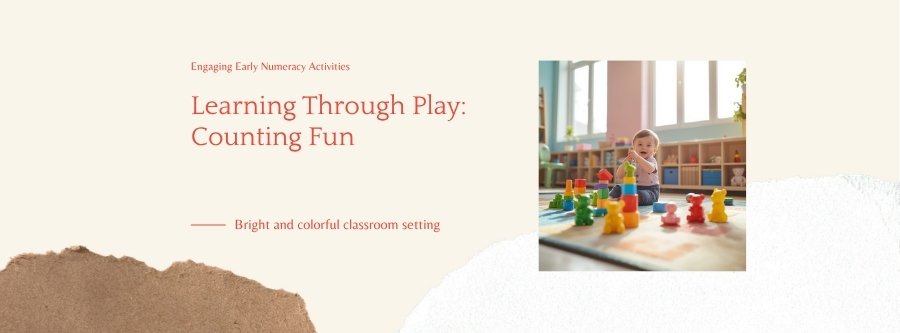
Young children learn mathematical concepts through concrete, hands-on experiences. Before they can understand the numeral “3,” they need hundreds of experiences counting three physical objects, grouping three things together, and seeing that three is always three regardless of what is being counted. Manipulatives (blocks, counters, beads, natural materials) are essential tools for building number sense.
Embedding Maths in Daily Life
Counting steps while climbing stairs, setting the table (“We need four plates, one for each person”), dividing snacks (“Let’s share these six grapes equally”), and comparing quantities (“Who has more blocks?”) all build mathematical thinking within meaningful contexts. When adults use mathematical language naturally and frequently, children absorb number concepts effortlessly.
Games and Play
Board games with dice and counting, cooking activities (measuring, counting ingredients), construction play (comparing sizes, counting blocks), and outdoor activities (collecting and sorting natural materials) all provide rich mathematical experiences. Songs that involve counting (forward and backward) build number sequence knowledge. Patterning activities (bead strings, block patterns) develop algebraic thinking.
Avoiding Common Mistakes
Drilling rote counting without building understanding of what numbers represent creates a superficial skill. Worksheets that ask children to trace numerals before they have built conceptual understanding put the abstract before the concrete. Correcting children harshly when they make counting errors discourages mathematical exploration. The goal is confident, curious mathematical thinkers, not children who can recite numbers without understanding them.
Educators who document mathematical learning alongside other developmental domains using Personhood360 can plan targeted numeracy experiences that build on each child’s current understanding, ensuring that every child develops strong mathematical foundations through play.