



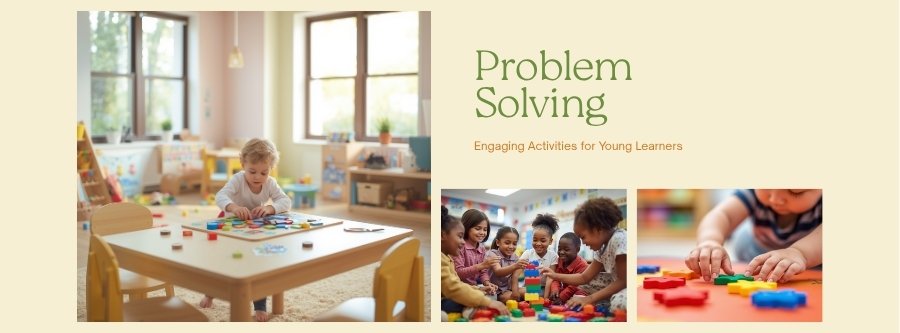
At four years old, children are experiencing a remarkable cognitive leap. Their thinking becomes more logical, their memory more reliable, their imagination more elaborate, and their curiosity seemingly boundless. Understanding what cognitive development looks like at this age helps parents and educators provide the right balance of stimulation and support.
Thinking and Problem-Solving
Four-year-olds are developing the ability to think through problems before acting. While a two-year-old might try to force a puzzle piece into the wrong space, a four-year-old can rotate pieces, compare shapes, and use trial-and-error strategically. They can sort objects by multiple attributes (colour and size), understand simple cause-and-effect relationships, and predict what might happen next in a familiar sequence.
They are beginning to grasp the concept of time, understanding “yesterday,” “today,” and “tomorrow”, though their sense of duration remains imprecise. They can follow multi-step instructions (up to three steps), recall events from the recent past in sequence, and plan simple activities.
Memory and Attention
Working memory, the ability to hold information in mind while using it, improves significantly at four. Children can remember and follow instructions with multiple steps, recall details from stories read to them, and remember where they put things. Their attention span extends to 10 to 15 minutes for engaging activities, though this varies widely depending on interest and temperament.
Imagination and Creativity
Perhaps the most striking cognitive development at four is the explosion of imaginative play. Four-year-olds create elaborate pretend scenarios with detailed storylines, assign roles to peers and toys, and maintain pretend play over extended periods. This is not mere entertainment. Imaginative play develops executive function, narrative skills, perspective-taking, and flexible thinking.
Four-year-olds also begin to distinguish between fantasy and reality, though the boundary remains fluid. They may insist that monsters are real while simultaneously understanding that a character in a book is “just pretend.” This evolving understanding is an important cognitive milestone.
Early Academic Concepts
By four, most children recognise and name several colours and basic shapes, can count to 10 or beyond with reasonable accuracy, recognise some letters (particularly those in their own name), and understand basic spatial concepts (above, below, beside, between). They ask an extraordinary number of questions, with “why” being the most popular, reflecting genuine curiosity about how the world works.
Supporting Cognitive Development at Four
The richest cognitive stimulation for four-year-olds comes through play, conversation, and exploration. Open-ended materials (blocks, loose parts, art supplies), challenging questions, and opportunities for self-directed investigation all promote cognitive growth. Resist the temptation to push formal academic instruction. Four-year-olds learn most effectively through hands-on, meaningful, play-based experiences.
Educators who track cognitive milestones within a broader developmental framework can identify each child’s strengths and interests and plan learning experiences accordingly. Personhood360 supports this approach by enabling educators to document cognitive observations alongside wellbeing, social-emotional, and physical development, creating a holistic profile that informs intentional, child-centred planning.