



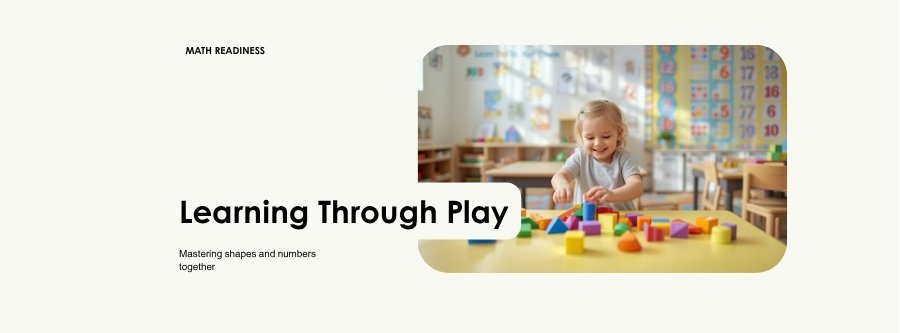
Parents often equate school readiness in maths with counting and number recognition. While these are important, the mathematical concepts that truly prepare children for school are broader, deeper, and best developed through play and exploration rather than formal instruction.
Number Sense
Beyond rote counting, children entering school ideally understand one-to-one correspondence (counting each object once), cardinality (the last number counted tells how many there are), and can compare small quantities (more, less, same). They can recognise small quantities without counting (subitising): seeing three dots and knowing “that’s three” without counting each one.
Patterns and Sorting
Recognising and creating patterns (red-blue-red-blue) is foundational algebraic thinking. Sorting objects by attributes (colour, size, shape, type) develops classification skills. These concepts underpin much of the mathematical reasoning children will encounter in formal schooling.
Spatial Awareness
Understanding positional language (above, below, beside, between, inside, outside), recognising and naming basic shapes (circle, square, triangle, rectangle), and understanding how shapes fit together (puzzles, construction) are critical spatial concepts. Spatial reasoning is increasingly recognised as a key predictor of mathematical and scientific achievement.
Measurement
Comparing objects by size (longer, shorter, taller), weight (heavier, lighter), and capacity (full, empty, half) develops measurement thinking. Children do not need formal units. They need experiences comparing and ordering objects using direct comparison and everyday language.
Building These Concepts Through Play
Block play, water play, cooking, gardening, construction, sorting collections, and outdoor exploration all build mathematical concepts naturally. The key is for adults to make the mathematics visible by using mathematical language and asking mathematical questions within these play experiences.
Educators who document mathematical learning using Personhood360 can identify each child’s mathematical understanding and plan experiences that build on their current knowledge, ensuring that every child develops strong mathematical foundations through meaningful, play-based learning.