



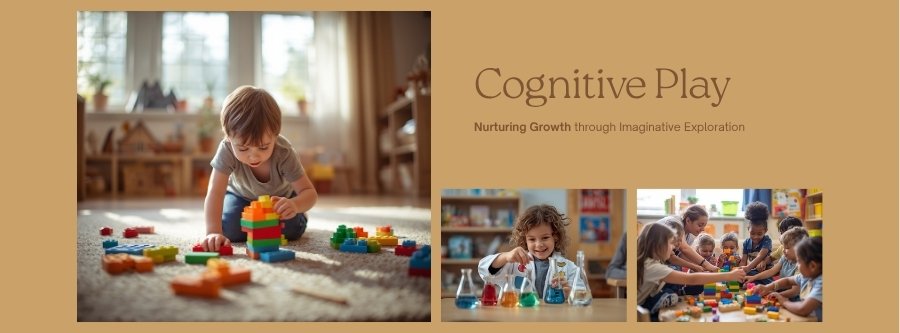
The idea that play is “just play”, a break from real learning, is one of the most persistent and damaging misconceptions in education. Neuroscience, developmental psychology, and education research all converge on the same conclusion: play is one of the most powerful drivers of cognitive development in the early years. Understanding how play builds the thinking brain helps parents and educators embrace it with confidence.
Play and Executive Function
Executive function, the set of cognitive processes that includes working memory, inhibitory control, and cognitive flexibility, is one of the strongest predictors of academic success. Remarkably, executive function develops more effectively through play than through direct instruction.
Pretend play is particularly powerful. When a child pretends that a banana is a telephone, they are exercising inhibitory control (suppressing the real identity of the object), working memory (maintaining the pretend scenario in mind), and cognitive flexibility (switching between reality and pretend). When pretend play becomes social, with roles, rules, and evolving storylines, these demands intensify, providing a rich cognitive workout.
Play and Problem-Solving
Play constantly presents children with problems to solve. How do I make this tower taller without it falling? How do I persuade my friend to play the role I want? How do I fit this piece into the puzzle? How do I pour water from a big container into a small one without spilling?
Unlike formal problem-solving exercises, play-based problems are intrinsically motivated. The child cares about the outcome because the play matters to them. This emotional engagement deepens learning and builds persistence, as children are willing to try multiple approaches when the problem is embedded in a meaningful context.
Play and Language
Language and cognition are deeply intertwined, and play drives both simultaneously. During pretend play, children produce more complex language than in any other context: longer sentences, more diverse vocabulary, more sophisticated narrative structures. They negotiate roles, describe imaginary scenarios, and explain their thinking to peers.
Play and Memory
Play also strengthens memory systems. Children who learn new concepts through play retain them more effectively than those who learn through direct instruction, because play provides multiple sensory, emotional, and contextual cues that create richer memory traces. A child who learns about volume by pouring water between containers will remember the concept more durably than one who hears a definition.
Implications for Early Childhood Practice
The evidence is clear: environments that prioritise play, with intentional design, responsive educators, and rich materials, produce stronger cognitive outcomes than those that prioritise early formal instruction. For educators, the challenge is to design play opportunities that are cognitively rich, document the learning that occurs within play, and communicate that learning to families and stakeholders.
Personhood360 supports this by enabling educators to link play-based observations directly to developmental domains, making the cognitive richness of play visible and valued.