



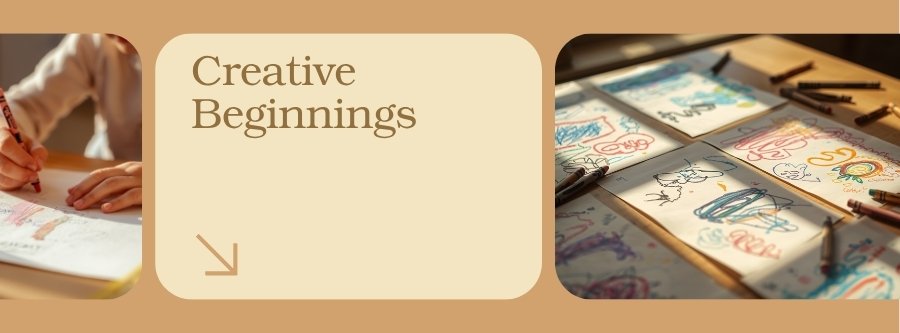
Writing development in early childhood follows a predictable sequence of stages, each building on the last. Understanding these stages helps parents and educators support emerging writers appropriately, celebrating progress at every step rather than pushing children toward outcomes they are not yet ready for.
Stage 1: Random Marks (12-24 months)
Toddlers make marks with whatever they can: crayons, fingers, sticks in mud. These marks are exploratory, with no representational intent. The child is learning that their actions produce visible results and developing the motor control needed for more deliberate mark-making.
Stage 2: Controlled Scribbling (2-3 years)
Scribbles become more controlled and purposeful. Children begin to distinguish between different types of marks (lines, circles, dots) and may assign meaning to their scribbles (“This is Mummy”). They are developing the understanding that marks can represent ideas.
Stage 3: Letter-Like Forms (3-4 years)
Children begin producing shapes that resemble letters, even if they are not yet conventional. They may write “pretend” shopping lists, letters, or signs using a mix of letter-like forms and actual letters. They understand that writing communicates meaning, even if their writing is not yet readable.
Stage 4: Early Letters (4-5 years)
Children begin writing recognisable letters, usually starting with those in their own name. Spacing is irregular, letters may be reversed or inconsistently sized, and children often mix upper and lower case. They may begin to connect letters to sounds, writing the first letter of a word to represent the whole word.
Stage 5: Emergent Writing (5-6 years)
Children begin to use invented spelling, representing sounds they hear with letters they know. “I LV MY DOG” demonstrates phonetic understanding even though the spelling is unconventional. This stage is a bridge to conventional writing and should be celebrated as evidence of sophisticated linguistic thinking.
Tracking writing development across these stages helps educators plan appropriate support. Personhood360 enables educators to document writing samples and observations alongside other developmental domains, creating a comprehensive record that celebrates progress and informs planning.