



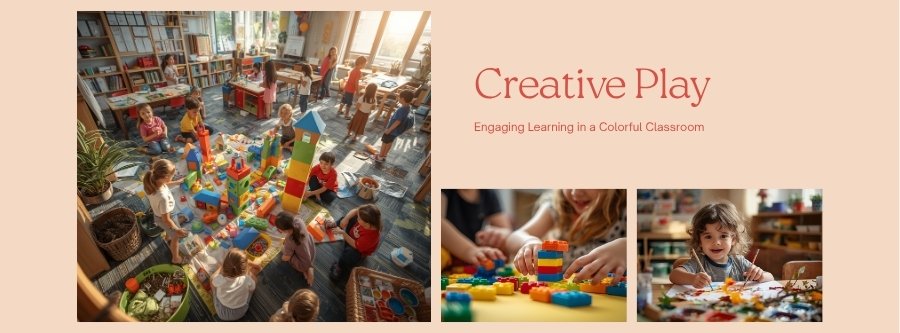
In early childhood education circles, “play-based learning” is one of the most frequently used, and occasionally misunderstood, terms. For some, it conjures images of children running freely with no structure or purpose. For others, it represents a progressive approach that sounds nice in theory but raises questions about rigour. The reality is far more nuanced, and the evidence supporting play-based learning is among the strongest in all of education research.
Defining Play-Based Learning
Play-based learning is an approach to education in which play is the primary vehicle for learning. It does not mean unstructured free-for-all. Rather, it involves educators who understand child development creating environments rich in provocations: materials, spaces, and experiences designed to invite exploration, investigation, and discovery. Children are active participants in their learning, following their interests and curiosities while educators observe, extend, and scaffold their experiences.
Within play-based learning, there is a spectrum from free play (entirely child-directed) to guided play (child-directed but shaped by educator design and interaction) to structured play (adult-initiated activities with playful elements). High-quality early childhood programs use all three, adjusting the balance based on children’s needs and learning objectives.
The Evidence
The research base for play-based learning is extensive and consistent. Studies across multiple countries and decades show that children who learn through play develop stronger cognitive skills (including executive function, problem-solving, and creative thinking), better social-emotional competence, and more positive attitudes toward learning than children in didactic, instruction-heavy programs.
Countries with strong play-based early childhood systems, notably the Nordic nations where formal academic instruction begins at age six or seven, consistently outperform countries that push early academics in international comparisons by the time children reach adolescence. This finding challenges the intuition that earlier formal instruction must be better.
What Children Learn Through Play
Through play, children develop language (through conversation, negotiation, and storytelling during pretend play), mathematical thinking (through sorting, counting, measuring, and building), scientific reasoning (through experimentation and observation), social skills (through cooperating, negotiating, and resolving conflicts), emotional regulation (through role-playing different scenarios and managing the frustrations of play), physical competence (through gross and fine motor activities), and creativity and imagination (through art, construction, drama, and invention).
Critically, play integrates these domains in ways that worksheets and formal instruction cannot. A child building a castle in the sandpit is simultaneously developing spatial reasoning, fine motor skills, vocabulary, narrative thinking, and social skills, all within a single, meaningful, intrinsically motivated experience.
The Educator’s Role
In play-based learning, the educator’s role shifts from instructor to facilitator, observer, and co-learner. Educators design rich environments, observe children’s play for learning opportunities, ask thought-provoking questions, introduce new vocabulary, and extend play by adding materials or provocations that deepen exploration. This requires deep knowledge of child development, keen observational skills, and the ability to plan responsively based on what children show interest in and readiness for.
Documenting play-based learning is essential for demonstrating its educational value and for planning future experiences. Tools like Personhood360 enable educators to capture the learning within play, linking observations to developmental domains and wellbeing markers, making the invisible visible and communicating the richness of play-based learning to families, colleagues, and regulators.